
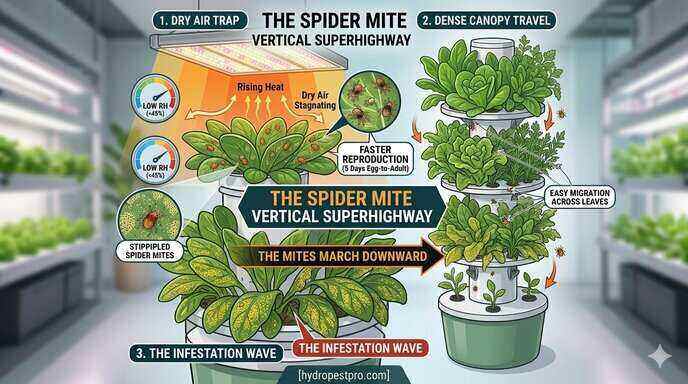
Few things match the sheer frustration of watching a towering, vibrant hydroponic system suddenly drop its vigor, show yellow stippling spots, or begin to wilt tier by tier. In a soil-less vertical setup, small structural advantages can quickly twist into systemic vulnerabilities. While many home growers immediately panic over nutrient ratios or pump failures, the real danger is often a microscopic, eight-legged invader. Spider mites are a catastrophic threat to vertical towers; they don’t just feed on leaves, they strip the plant’s vascular vitality from the top down. Because vertical systems pack dense foliage tightly together, these pests can travel across your entire crop before you notice the first strand of silk.
The most common trap is assuming that growing without soil makes your plants immune to classic greenhouse pests. I’ve seen many growers struggle with total crop failure because they didn’t realize how quickly a vertical tower’s micro-climate works in the mite’s favor. To immediately push back against a fast-moving infestation without fouling your clean water lines with synthetic poisons, take a look at our field-tested guide on the most effective natural spider mite killers for hydroponic vertical towers to secure your grow room safely.
Why Vertical Towers Form a Spider Mite Superhighway
Vertical hydroponic towers are masterpieces of space efficiency, but their mechanical design inadvertently provides the exact environmental triggers that spider mites need to supercharge their reproductive rate.
First, the heat from indoor grow lights naturally rises, creating localized pockets of hot, dry air at the highest tiers of your tower. Spider mites thrive in low relative humidity and warm temperatures; it shortens their egg-to-adult lifecycle to a mere five days. Second, vertical systems completely lack natural outdoor predators like predatory mites or lacewings. Finally, because the leaves of different plant tiers physically touch and drape over one another, the mites do not need to drop to the floor to spread. They use gravity and proximity to march effortlessly downward, transforming a localized issue on a single upper clone into an all-out, multi-level canopy invasion.
Read More: How to Tell the Difference Between Spider Mite Webbing and Dust on Hydroponic Leaves?
Step-by-Step Identification: Tracking the Microscopic Invaders
Because spider mites are smaller than a pinpoint, waiting until you see thick webs means you are already dealing with a massive colony. Grab a 10x jeweler’s loupe and inspect these precise tower zones:
- The Undersides of Upper Leaves: Flip over the leaves closest to your top grow lights. Look for tiny, moving specks that resemble crawling dust grains, accompanied by microscopic, translucent round eggs.
- The Intersections of Stems and Petioles: Examine the tight V-shaped joints where the leaf stems meet the main central tower core. This is where mites spin their initial, fine silk guidelines to travel between plant tiers.
- The Top Leaf Faces (Stippling Damage): Look closely at the upper surfaces of your foliage. If you spot thousands of tiny, bleached-white or pale yellow pinprick spots, the mites are actively puncturing the leaf cells to suck out chlorophyll.
- The Core Plastic Around Net Pots: Check the plastic framework of the tower right around your net cups and neoprene inserts. Mites will crawl across the structural plastic looking for fresh, unexploited green shoots to colonize.
The 3-Step Safe Organic Eradication Plan
You can completely dismantle a vertical spider mite colony without introducing oily chemical sprays that coat your system, scorch your leaves under intense lights, or throw off your reservoir’s delicate pH and PPM balances:
Step 1: The Manual High-Pressure Reset
Physically remove the infected plant segments or net cups from the tower if your system allows, or use a clean, targeted wand attachment to spray the undersides of the foliage with a firm stream of plain, pH-balanced water. This structural blast physically breaks down their delicate web networks and washes away up to 80% of the active adults and loose eggs instantly.
Step 2: Apply a Clean, Pure Suffocation Foliar
Once the canopy dries, spray the foliage thoroughly with a reservoir-safe, pure emulsified horticultural oil or a premium plant-derived formulation. Focus completely on coating the leaf undersides. This creates a microscopic, organic film that blocks the breathing pores of the mites without leaving chemical residues that can wash into your water and clog your pump filters.
Step 3: Unleash Hydro-Safe Biological Warfare
Introduce live, commercially bred predatory mites (Phytoseiulus persimilis) directly to the infected tiers. These beneficial bugs do not eat plants; they hunt down and consume spider mites and their eggs with relentless efficiency. They are 100% safe for indoor spaces and will naturally die off once their food source is completely eliminated.
Pro Prevention Habits for Spotless Vertical Systems
Once your vertical tower is free of pests, build these strict cleanroom protocols into your weekly maintenance schedule to keep them from coming back:
- Scrub Down the Tower Body Between Grows: When resetting your tower for a new crop, completely dismantle the plastic tiers and sanitize them with food-grade hydrogen peroxide to kill any dormant eggs hiding in the plastic seams.
- Install Fine Intake Filter Socks: Fit your grow room’s fresh air intake fans with micro-mesh filters. Wild spider mites are so light that they can easily be carried into an indoor tent through open vents on simple outdoor air currents.
- Maintain High Canopy Humidity: In my indoor tent, I found that placing a small humidifier near the base of the tower to keep the ambient relative humidity between 55% and 65% completely crippled the spider mite’s ability to hatch eggs.
- Sanitize Pruning Tools Constantly: Never move your trimming shears from an unverified outdoor houseplant straight to your clean hydroponic tower without dipping the blades in isopropyl alcohol first.
Frequently Asked Questions
Can I use neem oil in an active hydroponic vertical tower?
Be incredibly cautious with raw neem oil in vertical systems. If heavy neem oil drips off the leaves and enters your nutrient solution, it will form a thick, greasy film on the surface of your reservoir, coating your water pumps and suffocating your plant’s roots. Stick to specialized, clean-rinsing horticultural washes instead.
Why did spider mites appear on my tower when I grow entirely indoors?
Mites almost always enter indoor rooms via two vectors: hitchhiking on your clothes after you walk through an outdoor yard, or riding in on contaminated clones or starter plugs purchased from an unverified commercial greenhouse.
How often should I spray my tower to break the mite lifecycle?
Because spider mite eggs hatch incredibly fast in warm indoor environments, a single spray will not cut it. You must repeat your safe organic foliar applications every 3 to 4 days for at least two full weeks to kill the newly hatched nymphs before they can mature and lay new eggs.
Conclusion
Vertical hydroponic towers offer unparalleled indoor yields, but their unique vertical micro-climate demands vigilant pest management. By recognizing how dry air pockets drive mite reproduction, utilizing physical water resets, and deploying root-safe biological controls, you can keep your vertical system pristine, productive, and completely pest-free.
Expert Tip: To easily monitor your tower’s vulnerability, mount a digital hygrometer probe at the absolute top tier of your vertical system right under the lights, not just at floor level. If the top-tier humidity drops below 45%, your upper plants are in the spider mite danger zone. Increasing your room’s overall air circulation or adding a top-down misting cycle will instantly make the environment hostile to colonizing scouts.