
There is nothing quite like the crushing disappointment of watching your thriving indoor hydroponic basil or mint suddenly exhibit mystery yellow stippling or unexplainable leaf wilt just weeks before harvest. In a soil-less environment, a sudden insect invasion is an immediate crisis. Because your herbs are essentially clean water and pure nutrients wrapped in delicate plant tissue, pests like spider mites or thrips can systematically drain an entire canopy’s vitality in days. When bugs threaten your kitchen garden so close to harvest, you are forced into a tight spot: you need a powerful remedy that stops the damage instantly, but it must be safe enough to spray on food you intend to eat very soon.
The trick is balancing explosive pest knockdown power with consumer safety. I’ve seen many growers struggle with application timing, inadvertently ruining the taste of their fresh herbs or risking chemical residues on their dinner plates. If you are battling an active, late-stage infestation right now and need an organic solution that will not leave a permanent chemical footprint in your system, be sure to read our detailed review of the safest liquid pyrethrin for DWC to clear your canopy instantly while keeping your root zone completely protected.
Why Harvest Timing is So Critical in Indoor Hydroponics
Indoor grow tents are closed, synthetic ecosystems. We intentionally lock in optimal warmth, consistent humidity, and stable airflow to push our herbs to peak yields. Unfortunately, this isolated environment is also an artificial utopia for sap-sucking pests. Without natural outdoor predators like ladybugs or parasitic wasps to stall their growth, a tiny population can explode exponentially.
Many home growers introduce these destructive hitchhikers entirely by accident, usually via contaminated cuttings shared by friends or by walking into their clean grow room straight from an outdoor backyard garden. When you spray an organic compound like liquid pyrethrin close to your harvest date, you must account for its degradation rate. While pyrethrin is a natural botanical extract derived from chrysanthemum flowers, spraying it too frequently or too close to cutting your herbs can leave behind bitter flavors or unwanted botanical residues. Because hydroponic herbs lack soil microbes to help break down surface compounds, understanding the exact frequency of application is the only way to protect your harvest.
Read More: Why Synthetic Insecticides Crash Deep Water Culture (DWC) Reservoir pH Overnight?
Step-by-Step Identification: Checking Herbs Before Spraying
Before you pull out a spray bottle, you must inspect your herbs thoroughly to determine if a late-stage application is truly necessary. Grab a 10x jeweler’s loupe and inspect these precise structural zones:
- The Undersides of Tender Leaf Tips: Gently flip over the topmost leaves. Sucking pests cluster away from direct overhead grow lights to feed and deposit their glassy, translucent eggs.
- Tight Stem Crevices and Junctions: Examine the tight nooks where leaf stems join the main stalk. If you spot microscopic, shimmering silk webs, a colony is rapidly expanding.
- The Rockwool or Clay Pebble Surface: Inspect the top of your growing media. Fungus gnat adults frequently crawl around these damp zones searching for places to lay root-destroying larvae.
- Bare Root Uniformity: Take a moment to lift your net pots and inspect the root mass. Healthy roots should be pearly white; if they look dull or slimy, your system may already be suffering from dripping spray runoff.
The 3-Step Safe Pre-Harvest Treatment Plan
To safely apply liquid pyrethrin to your hydroponic herbs without crashing your water chemistry or leaving unwanted residues at harvest, use this systematic approach:
Step 1: Shield the Hydroponic Reservoir
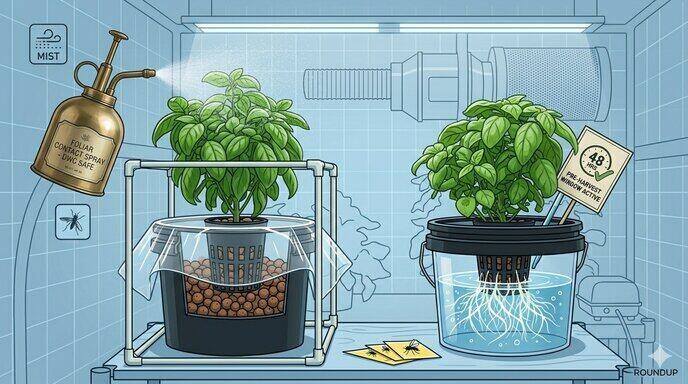
Never let pesticide droplets enter your clean water loop. Cut a slit into a clean plastic trash bag or a sheet of plastic wrap and slide it tightly around the base of your herb stems to completely cover the net pot and reservoir lid. This prevents any chemical runoff from unbalancing your pH or PPM.
Step 2: Apply with a Strict 48-Hour Harvest Window
Mix your liquid pyrethrin concentrate at a minimal, effective dose and thoroughly mist the foliage, focusing entirely on hitting the pests directly. Do not spray your herbs within 48 hours of harvest. While pyrethrin breaks down incredibly fast under light, giving your plants a clear 2-to-3-day window guarantees that the active botanical compounds evaporate entirely before you pick your crop.
Step 3: Utilize the “Lights-Out” Degradation Window
Always apply your pyrethrin treatment right after your grow lights click off for the dark cycle. If you spray your herbs under intense, running LED or HPS lights, the wet droplets will act like tiny magnifying lenses, causing severe leaf burn and cosmetic tissue damage. Furthermore, pyrethrin degrades rapidly under UV and bright light; applying it at night gives it a long, dark window to maximize its insect knockdown power before dissipating.
Pro Advice to Prevent Pest Re-Entry
Once your canopy is clean and your herbs are safely harvested, implement these preventative habits to keep your future grow cycles entirely bug-free:
- Install Fine Insect Air Intake Screens: Cover your tent’s intake fans with a fine-mesh screen or a dedicated insect filter to block incoming flying pests from getting pulled into your clean room.
- Keep Active Sticky Traps Near the Base: Hang rigid yellow adhesive stakes directly above your reservoir lids. They won’t cure a full outbreak, but they serve as a critical early warning mechanism by catching scouting insects.
- Sanitize Pruning Tools Constantly: In my indoor tent, I found that wiping my trimming shears with 70% isopropyl alcohol between plants completely eliminates the accidental spread of microscopic pest eggs.
- Enforce a Strict Wardrobe Change: Never enter your indoor hydroponic room wearing the same clothes you wore while working in an outdoor garden or visiting a local plant nursery.
Frequently Asked Questions
Will liquid pyrethrin change the flavor of my indoor herbs?
If you follow the 48-hour pre-harvest interval rule, the pyrethrin will break down completely, leaving no trace behind. However, if you spray the day of harvest, your herbs may carry a bitter, medicinal taste. I always recommend giving your leaves a gentle misting with plain, pure water 24 hours before harvest to wash away any lingering botanical scents.
Can I mix a liquid pyrethrin solution directly into my hydroponic reservoir?
No, you should never pour pyrethrin into your reservoir water. Pyrethrin is strictly a foliar contact insecticide. Adding it directly to your water culture buckets will coat your bare root hairs in an impenetrable film, stripping them of their ability to absorb dissolved oxygen and vital nutrients, which will quickly kill your plants from the bottom up.
How many times can I repeat this spray treatment safely?
You can safely repeat a pyrethrin application once every three to five days. Because pyrethrin only kills live insects on contact and does not destroy unhatched eggs, a repeating schedule for a minimum of two weeks is necessary to catch new larvae as they emerge.
Conclusion
Liquid pyrethrin is an incredibly effective, plant-derived weapon for saving a late-stage hydroponic herb garden, provided you respect the pre-harvest countdown. Keep your application frequency capped at once every few days, isolate your reservoir from any potential dripping, and always allow a clean window before cutting your fresh herbs.
Expert Tip: If you want absolute peace of mind regarding the purity and flavor of your hydroponic herbs, try running a “pure water wash” right before harvest. Roughly 24 hours after your last pyrethrin treatment has dried, fill a clean pressure sprayer with pure, pH-balanced water and thoroughly rinse down the leaves. This final wash lifts away any harmless, spent botanical oils or dead insect fragments, ensuring your final harvest looks pristine and tastes exactly like it should.