
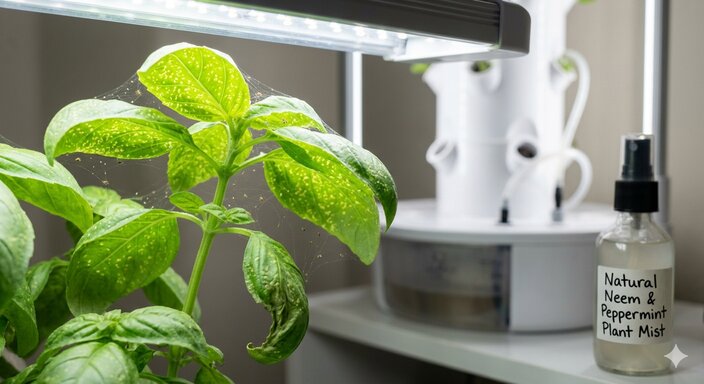
There is nothing quite as heart-sinking as walking into your grow room to find a vibrant, lush basil plant suddenly looking “off.” You notice a slight yellowing, perhaps some tiny white speckles, or a subtle wilt that doesn’t go away after a nutrient top-off. In an indoor soil-less system, these small signs are usually the first warning shots of a pest invasion. Unlike outdoor gardens where nature provides a balance, a hydroponic tent is a closed loop; once a pest like the spider mite or fungus gnat gets in, they face no predators and can multiply fast enough to collapse a small tower in days. This rapid spread makes it crucial to deploy targeted, clean interventions, such as organic spider mite treatments for vertical systems, before the infestation compromises your entire water loop.
The Direct Answer: Proceed with Caution
You can spray peppermint oil on your plants, but never apply it at full strength. Pure essential oils are highly volatile and can cause “leaf burn” or permanent damage to the delicate stomata (the pores) of your plants. To get the deterrent benefits without the risk, I’ve found that using a pre-stabilized, professional-grade Natural Neem Spray is a much safer bet.
However, if you are already seeing active webbing or yellow spotting, peppermint alone usually won’t be enough to save the crop. In my experience, you’ll need to move to a more targeted organic treatment to fully eradicate the colony. If you’re currently fighting an outbreak in your tower, you can check out my top 5 recommendations here for solutions that actually work without gunking up your hydroponic lines.
Why Pests Thrive in Hydroponics
I’ve seen many growers struggle with pests and wonder how they even got inside. In a hydroponic environment, we create a “perfect” climate—consistent warmth and high humidity—which pests love just as much as your lettuce does.
- No Natural Predators: Inside a tent, there are no ladybugs or lacewings to keep mite populations in check.
- Contaminated Clones: Most infestations start from a “gifted” cutting or a new plant brought in from a nursery that was already carrying invisible eggs.
- Stagnant Air: If your ventilation isn’t pushing air through the center of the plant canopy, you’re creating a humid sanctuary for fungus and bugs.
How to Identify the Threat
Before you spray anything, you need to know what you’re fighting. Grab a magnifying glass and check these specific spots:
- Underside of Leaves: Look for tiny moving dots (mites) or microscopic white “dust” (eggs).
- The Rockwool/Media Surface: Check for tiny black “flies” (fungus gnats) hopping near the base of the stem.
- New Growth: If the youngest leaves are curling or look “stunted,” pests are likely sucking the sap from the plant’s most tender parts.
- Silky Webbing: In advanced stages, you’ll see fine webs stretched between the stems of your vertical tower.
Your 3-Step Organic Treatment Plan
If you catch an infestation early, you can fix it without reaching for toxic chemicals that would ruin your nutrient reservoir.
- The Mechanical Knockdown: Use a gentle stream of water to physically wash as many pests as possible off the leaves. Do this away from your reservoir to avoid washing bugs into your water.
- Apply a Diluted Botanical Mist: Use your peppermint-neem blend or a hydrosol. Spray the leaves thoroughly, focusing on the undersides, and always do this just before the lights turn off to prevent light-amplified leaf burn.
- Repeat the Cycle: Pests hatch in cycles. You must spray every 3 to 5 days for at least two weeks to ensure you are killing the new generation as they emerge from their eggs.
Pro Habits for Prevention
In my indoor tent, I found that an ounce of prevention really is worth a gallon of cure.
- Yellow Sticky Traps: Place these near the base of your plants. They act as an “early warning system” so you see the first gnat before it becomes a colony.
- Strict Quarantine: Never move a plant from your outdoor garden into your hydroponic room without a 14-day isolation period.
- Sterilize Your Tools: Wipe down your pruning shears with 70% isopropyl alcohol between every use.
- HEPA Air Filtration: Use a carbon filter or a fine intake screen to stop flying pests from being sucked into your grow room through the fan lines.
FAQs
Does peppermint oil kill bugs or just repel them? Peppermint oil primarily acts as a repellent. While the menthol can overwhelm small insects, it is best used as a “shield” to keep bugs from landing, rather than a “poison” to kill an established infestation.
Will peppermint oil affect the taste of my herbs? If you use a water-based hydrosol or a diluted spray and stop at least 48 hours before harvest, the scent usually dissipates. However, never spray flowers or oily herbs right before eating.
Can I put peppermint oil directly into my nutrient reservoir? No. Oils float on top of the water and can coat the roots, preventing them from absorbing oxygen. This can lead to root rot and “suffocate” your plants.
Final Thoughts
Using natural oils like peppermint is a brilliant way to keep your indoor garden “clean” and food-safe. It’s all about balance—treating the plants gently while being relentless with your consistency.
Expert Tip: If you are DIY-ing your spray, always perform a “patch test” on one single leaf. Wait 24 hours; if the leaf doesn’t curl or turn brown, you’re safe to spray the rest of the garden.